
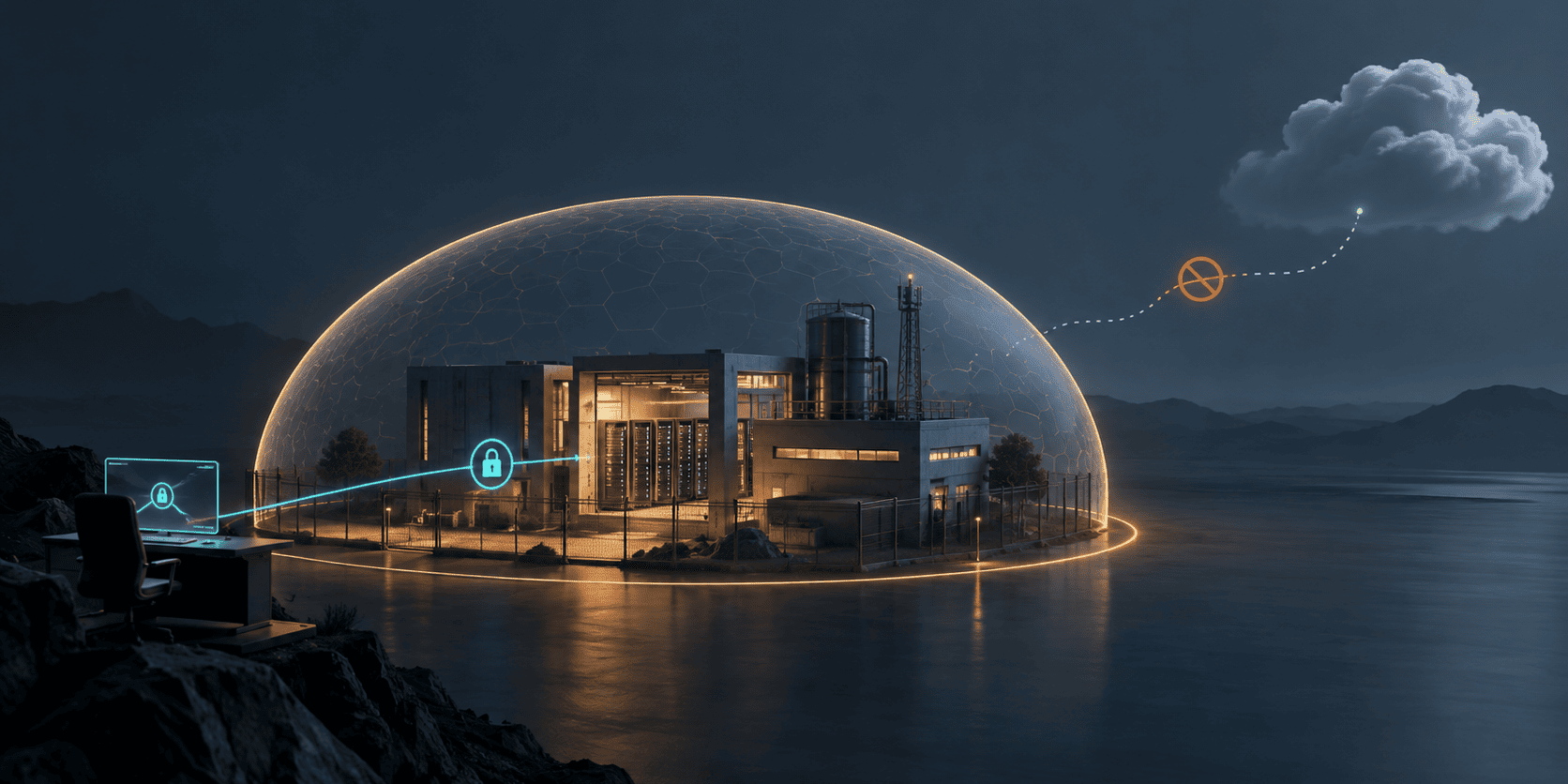
A critical workstation stops responding. The issue requires specialist attention, but the system operates inside a restricted network with no connection to the public internet.
In a typical enterprise environment, the next step might be straightforward: initiate a remote support session, investigate the problem, and restore operations. But what happens when the usual remote access tools depend on cloud infrastructure that the organization cannot, or is not permitted to, use?
For government agencies, defense organizations, industrial facilities, and critical infrastructure operators, this is more than a technical inconvenience. It raises an important question about how security and operational continuity can coexist when external connectivity is deliberately restricted.
When Isolation Is a Requirement, not a Limitation
Cloud technology has fundamentally changed how organizations manage their IT environments. Remote access, centralized administration, and technical support have become increasingly accessible, allowing teams to maintain systems across different locations with relatively little friction.
Yet the convenience of cloud-based services often rests on an assumption: that an organization’s infrastructure can communicate with external platforms. For certain environments, that assumption simply does not hold. Defense networks, sensitive government systems, industrial control environments, and other critical operations may need to remain isolated from public networks. In some cases, this means strict segmentation and controlled connectivity. In others, it means fully air-gapped systems, physically separated from external networks. These measures exist to protect sensitive information, reduce exposure to cyber threats, and preserve control over essential infrastructure. However, the need for maintenance, troubleshooting, and technical intervention does not disappear simply because a network is isolated.
Removing external connectivity does not remove the need for technical support.
It changes the conditions under which that support must be delivered.
The Operational Challenge Behind Restricted Access
The consequences of limited remote access are not always immediately visible. A technical issue that might take minutes to investigate in a conventional IT environment can require significantly more coordination when the affected system is located inside a restricted facility. Specialist personnel may need physical access. Maintenance activities may have to be scheduled around operational requirements. An issue affecting a relatively small component can remain unresolved longer than necessary, simply because the appropriate expertise is not available on-site. Across geographically distributed facilities, these challenges become even more pronounced. There is also a broader consideration. Organizations invest heavily in protecting critical systems from unauthorized access, yet the ability to provide timely, authorized support is itself an important part of maintaining a resilient infrastructure. Security cannot be measured exclusively by how effectively access is prevented. It must also account for how carefully legitimate access is enabled and governed. The real challenge, therefore, is not finding a way around network restrictions. It is ensuring that essential technical operations can continue within them.
Rethinking the Architecture of Remote Access
Remote access is frequently associated with connecting through the internet, but the two are not inherently dependent on each other. What matters is the architecture through which connections are established, authenticated, managed, and monitored. A remote support platform that relies on an externally hosted service introduces a dependency that may be perfectly acceptable in a conventional enterprise network, but incompatible with a restricted environment.
A self-hosted approach changes that relationship.
By deploying remote access infrastructure within an organization’s own environment, the mechanisms responsible for managing connections can remain under its direct control. Authentication, permissions, certificates, and operational records can be governed according to internal security policies rather than depending on an external cloud platform.
This is the approach supported by the Netop Self-Hosted Portal, which provides centralized remote access management through a containerized architecture deployed within customer-controlled infrastructure. Designed to support on-premises, private-cloud, and isolated environments, the Portal allows organizations to manage authorized remote connections without requiring Netop’s external cloud services for normal operation.
In an air-gapped environment, that means remote support can take place between permitted systems within the isolated network, without compromising its separation from external infrastructure. Access from outside that boundary would still require an explicitly approved and technically available connection path. The distinction is important. Self-hosted remote access does not eliminate security boundaries or make every system accessible. It allows organizations to establish and manage support capabilities within the boundaries they have already defined. And that brings the conversation beyond the location of the infrastructure. It becomes a question of who controls access, who can authorize a connection, how activity is recorded, and whether the organization can maintain visibility over every remote interaction.
Security Should Enable Resilience, Not Stand Apart from It
As IT environments become increasingly complex, organizations face a difficult balancing act. They must minimize exposure to external threats while ensuring that critical systems remain maintainable, supportable, and operational. These objectives are sometimes treated as competing priorities. In reality, they are closely connected. A secure environment that cannot be maintained efficiently may introduce operational risks of its own. Equally, convenient remote access without sufficient governance can undermine the protections that critical infrastructure depends upon. The answer is not necessarily greater connectivity or stricter isolation. It is an architecture that reflects the purpose, sensitivity, and operational requirements of each environment. For some organizations, cloud-based remote access will remain the most practical option. For others, maintaining direct control over access infrastructure will be essential. Neither approach should be considered universal.
Ultimately, the future of secure remote access is not about making every system accessible from everywhere. It is about ensuring that the right people can access the right systems, through approved paths, under the right conditions. Because the purpose of a security boundary is not to make essential operations impossible. It is to ensure they can take place without compromising what that boundary was designed to protect.
Lena Bramou
Operations Manager, Akeydor Group